Global-Shutter Sensors for Robot Tracking and Egocentric Capture: OV9281, AR0234, IMX296 and Alternatives
Which global-shutter image sensors suit robot tracking cameras and egocentric RGB, what changes between a sensor datasheet and a shipping module, and the lens and filter mistakes that break near-infrared tracking.
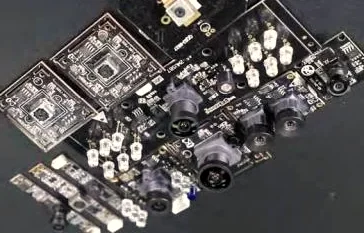
For monochrome tracking cameras, the OV9281/OV9282 (1280×800, 3 µm, up to 120 fps) remain the default; OV2311 adds 2 MP with enhanced near-infrared. For egocentric RGB, AR0234 (1920×1200, 2.3 MP, global shutter) is the common choice, with IMX296 and OG02B10 as alternatives. The module, lens and trigger path matter more than the sensor.
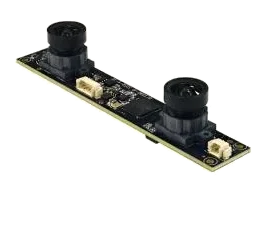
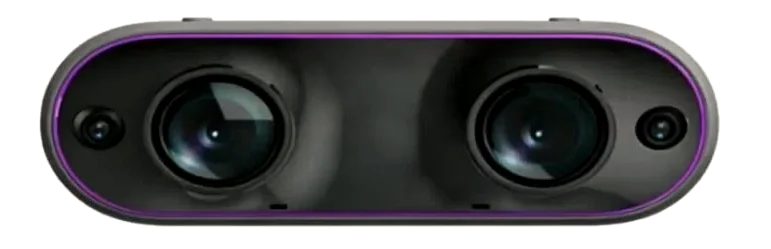
Sensor choice is the decision teams make first and should worry about last. The same sensor behaves very differently depending on the module’s board, lens, filter, interface and driver. This guide covers the sensors that dominate robot tracking and egocentric capture in 2026, then the module-level details that decide whether they work.
The shortlist
| Sensor | Colour | Resolution | Optical format / pixel | Max frame rate (sensor) | Typical role | Notes |
|---|---|---|---|---|---|---|
| OV9281 | Mono | 1280×800 (1 MP) | 1/4” · 3 µm | 120 fps | Tracking / SLAM cameras | External frame sync supported; very widely supported in modules |
| OV9282 | Mono | 1280×800 | 1/4” · 3 µm | 120 fps | Tracking cameras | Different chief ray angle (27°) and packaging from OV9281 — lens-dependent |
| OV2311 | Mono | 1600×1300 (2 MP) | 3 µm | 60 fps | Higher-resolution tracking | Enhanced NIR response; new lens and bandwidth budget |
| AR0234CS | Colour / mono variants | 1920×1200 (2.3 MP) | 1/2.6” · 3 µm | 120 fps | Egocentric RGB | Common in USB and MIPI modules; ordering code sets colour/mono |
| AR0235CS | Colour / mono | 1920×1200 (2.3 MP) | 1/2.8” | 120 fps | Next-generation RGB | Newer; module availability still maturing |
| IMX296LQR | Colour | 1456×1088 (1.58 MP) | 1/2.9” · 3.45 µm | 60 fps | Compact RGB | Below 2 MP — do not call it a 2 MP camera |
| OG02B10 | Colour | 1600×1300 (2.08 MP) | 1/2.9” · 3 µm | 60 fps | RGB alternative | Mono sibling OG02B1B; check module ISP frame rate |
Chinese sensor makers now offer 2 MP global-shutter parts used in several Shenzhen egocentric headsets. They are worth evaluating on cost and supply, with the same module-level checks below.
Rolling vs global shutter, briefly
A rolling-shutter sensor exposes and reads rows in sequence. During fast head turns or hand motion, straight edges bend and features shear, which corrupts visual odometry and the geometry of hand-object interaction. Global-shutter sensors expose all pixels simultaneously. For tracking cameras, global shutter is non-negotiable. For egocentric RGB it is strongly preferred; rolling-shutter phone cameras remain acceptable for large-scale video where geometry is secondary.
Sensor ≠ module
What you buy is a module, and the module decides five things:
Delivered frame rate and format. An AR0234 sensor rated at 120 fps often ships in USB modules delivering 1080p at 60 fps in MJPEG, or in MIPI modules delivering 30 fps YUV through an ISP. Specify the delivered mode — resolution, fps, RAW/YUV/MJPEG — in the purchase order.
Trigger access. Hardware synchronisation needs the sensor’s frame-sync input routed to a connector pin, and exposure controllable by your system rather than independent auto-exposure on each module. Many cheap modules do not expose it.
Timestamp and metadata. Can the module embed frame counters or exposure timestamps? If not, timestamps come from the host on arrival.
Driver. A MIPI module is only as good as its Linux driver for your exact host (Jetson L4T version, Rockchip BSP). Ask for the driver source and the tested host list.
Supply. Some popular IMUs and sensors face allocation constraints; confirm lifecycle and second sources before you design them in.
Indicative public prices in 2026 show the spread: bench OV9281 USB/MIPI modules from about USD 30, industrial MIPI OV9281 modules with documented trigger around EUR 60–65 at volume, and AR0234 MIPI modules with ISP around USD 300. Lenses are often extra.
Lenses and filters: where NIR tracking breaks
Tracking cameras increasingly double as infrared-LED trackers (for handheld controllers or body trackers emitting around 850 nm). Three mistakes recur:
- IR-cut filters. Many fisheye lenses ship with an IR-cut coating (e.g. 650 nm cut-off). It silently blocks 850 nm LEDs. Specify “no IR-cut” or a dual-bandpass filter (visible + ~850 nm) and verify the transmission curve.
- FOV on the actual sensor. A lens rated “186°” is rated for an image circle, not for a 1/4” sensor’s active width. Ask for the distortion and FOV plot computed for your sensor’s active area (3.84 mm wide for OV9281) and measure horizontal FOV on a real unit.
- IR focus shift. A lens focused in visible light can be soft at 850 nm. IR-corrected lenses specify the focal shift across 550–850 nm.
What to write in the RFQ
- Sensor part and variant (colour/mono, CRA) and delivered resolution, fps and format
- Frame-sync input exposed, exposure control method, embedded metadata
- Lens: focal length, F-number, horizontal FOV on this sensor, filter type and transmission at 850 nm
- Interface, host platform, driver source and BSP version
- Sample quantity, lead time, lifecycle and second-source options
For synchronisation targets and how to verify them, see Timing Is the Spec. For moving the streams to a computer, see choosing the camera link.
Frequently asked
Why do robots need global-shutter cameras?
A rolling-shutter sensor reads rows at different times, so fast motion bends straight lines and smears features. Global-shutter sensors expose every pixel at the same instant, which keeps geometry correct for visual odometry, tracking and hand-object interaction.
Is OV9281 or OV9282 better for tracking?
They share 1280×800 resolution and 120 fps, but differ in chief ray angle and packaging. The right choice depends on the lens: wide fisheye lenses must match the sensor's chief ray angle to avoid shading and colour or sensitivity fall-off at the edges. Ask the module maker which one their lens design supports.
Can an AR0234 module deliver 120 fps?
The sensor supports up to 120 fps at full resolution, but most shipping modules deliver 30–60 fps because of the ISP, interface and driver. Always specify the delivered resolution, frame rate and format of the module, not the sensor.
HOLON (2026). Global-Shutter Sensors for Robot Tracking and Egocentric Capture: OV9281, AR0234, IMX296 and Alternatives. HOLON-GDE-2026-004, v1.0. https://www.holonai.ai/research/global-shutter-sensors-robotics