Holon Labs: Event Cameras for Ultrafast Defect Inspection
How neuromorphic (event-based) imaging catches dynamic defects that frame cameras blur, where it fits in industrial inspection and robotics, and how we pilot it.
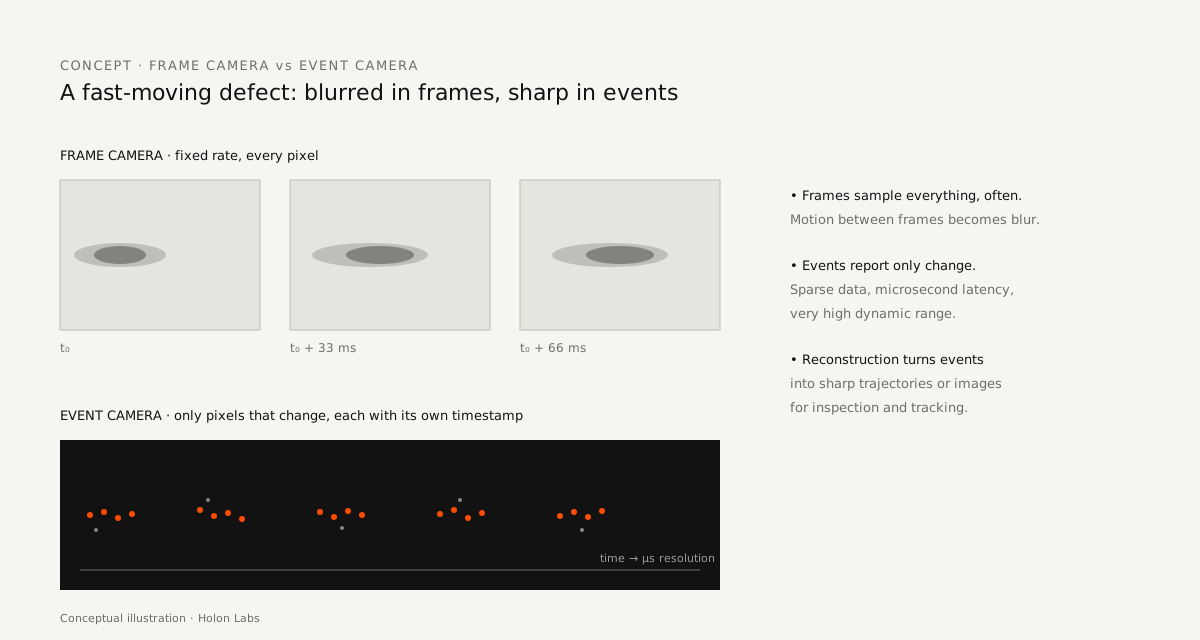
Event cameras report per-pixel brightness changes asynchronously with microsecond-scale latency instead of full frames, so fast-moving or vibrating defects that blur in a frame camera stay sharp in event data. Combined with computational reconstruction, they make it practical to inspect dynamic processes at speeds and data rates frame cameras cannot match.
Why frames struggle with fast defects
A conventional camera samples every pixel at a fixed rate — 30, 60 or a few hundred times a second — and integrates light over the exposure. A crack on a spinning part, a chipped tooth on a gear, a loose fastener vibrating at a few hundred hertz: between two frames these move far, and within one exposure they smear. Raising the frame rate helps, but bandwidth, storage and lighting requirements rise with it.
What event cameras do differently
An event camera’s pixels each watch for change. When the log brightness at a pixel moves past a threshold, that pixel emits an event — its position, polarity and a microsecond timestamp. There is no frame. Static background generates almost nothing; a moving edge generates a dense, precisely timed trail.
Three properties matter for inspection:
- Temporal resolution in the microsecond range, so motion is sampled finely enough to stay sharp.
- Sparse data, so continuous monitoring is feasible on modest compute and links.
- High dynamic range, so reflective metal, flicker and mixed lighting on a production line are less of a problem.
From events to a decision
Raw events are not an image. Computational reconstruction — combining the event stream with models of the motion and the optics — turns them into sharp trajectories, motion-compensated images or features a classifier can use. This is where most of the engineering lives, and where our lab’s research focuses.
Where it fits
- Rotating and reciprocating parts: fans, spindles, gears, belts.
- High-speed lines where products pass faster than a frame camera can resolve.
- Vibration and looseness detection where the signal is small, fast and intermittent.
- Robot perception under fast motion and difficult lighting.
How we pilot it
We start with a short feasibility run on your part or line: event and frame cameras side by side, a defined defect set, and a measured comparison of what each detects. If events win, we scope the sensor, optics, compute and integration.
Research behind this note
Our team’s published work on computational neuromorphic imaging includes:
- Zhu, S., Yin, Q., Wang, C., Huang, J., & Lam, E. Y. (2025). Ultrafast dynamic defect inspection with computational neuromorphic imaging. Advanced Science. doi:10.1002/advs.202510338
- Zhu, S., Ge, Z., Wang, C., Han, J., & Lam, E. Y. (2024). Efficient non-line-of-sight tracking with computational neuromorphic imaging. Optics Letters 49(13). doi:10.1364/OL.530066
The illustration above is conceptual and does not reproduce figures from these papers.
Frequently asked
What is an event camera?
A sensor whose pixels work independently and report only when the brightness they see changes, each with its own microsecond timestamp. Static scenes produce almost no data; motion produces a sparse stream of events.
When is an event camera better than a high-speed camera?
When the interesting thing is fast, small and intermittent, and you need to watch continuously. High-speed cameras record everything at very high data rates for short bursts; event cameras record only change, so they can run continuously at low bandwidth with very high dynamic range.
HOLON (2026). Holon Labs: Event Cameras for Ultrafast Defect Inspection. HOLON-LAB-2026-001, v1.0. https://www.holonai.ai/research/lab-event-camera-defect-inspection