Holon Labs: Neuromorphic Imaging for Tracking Around Corners
Non-line-of-sight tracking with event cameras: what it is, why event data makes it efficient, and what it could mean for robots and safety systems in cluttered spaces.
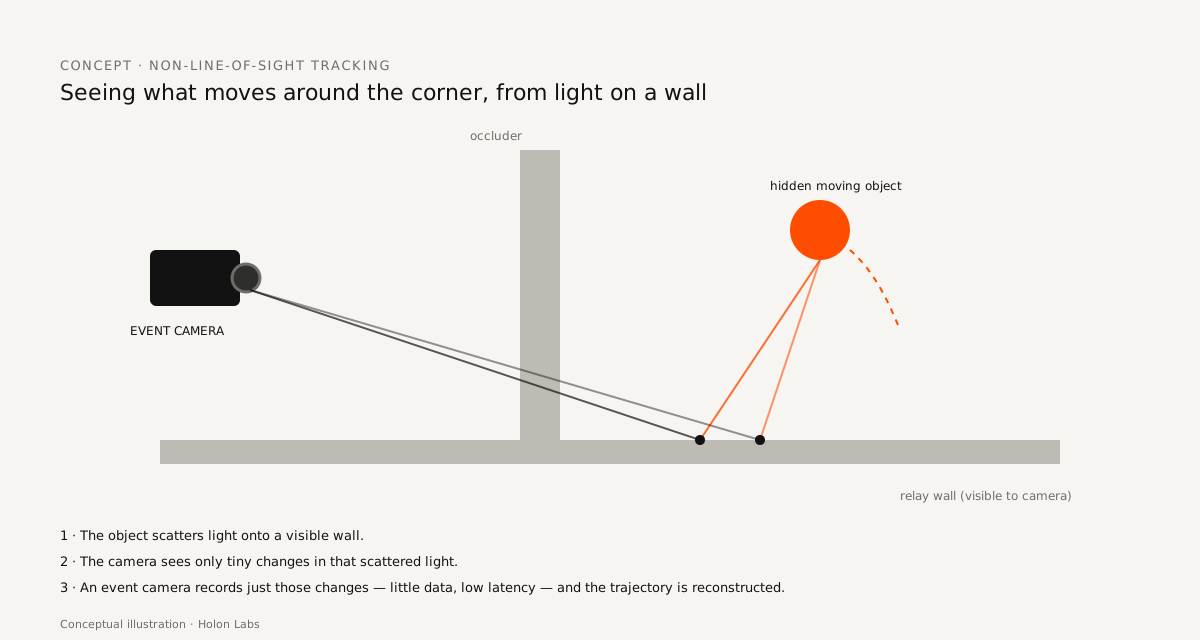
Non-line-of-sight tracking infers where a hidden object is by analysing light it scatters onto visible surfaces. Event cameras make this efficient because they record only the small changes in that scattered light, cutting data and latency compared with frame-based approaches.
The idea
A moving object out of view still changes the light in the room. Some of that light reaches a visible surface — a wall, a floor, a door frame — and the pattern on that surface changes as the object moves. Non-line-of-sight (NLOS) tracking recovers the hidden object’s position from those changes.
Why event cameras help
The useful signal is a small change on top of a mostly static scene. A frame camera spends its bandwidth re-recording the static parts; an event camera records only the changes, with microsecond timing. That makes the data far smaller and the latency lower, which is what a real-time tracker needs.
Where it could matter
- Robots in cluttered spaces — anticipating people or forklifts approaching from behind shelving or around corners.
- Safety systems — early warning at blind intersections in warehouses and plants.
- Inspection — watching motion inside enclosures through a visible aperture.
Status
This is research-stage work in our lab. We share it because it shows the direction of the team: sensing that extracts more information per bit, which matters as much for capture hardware as for perception.
Research behind this note
Zhu, S., Ge, Z., Wang, C., Han, J., & Lam, E. Y. (2024). Efficient non-line-of-sight tracking with computational neuromorphic imaging. Optics Letters 49(13), 3584–3587. doi:10.1364/OL.530066
The illustration above is conceptual and does not reproduce figures from the paper.
Frequently asked
Can a camera really see around a corner?
Not directly. It sees how light from the hidden scene changes on a visible surface, such as a wall or floor, and reconstructs the hidden motion from those changes. The signal is faint, which is why sensor choice and reconstruction matter.
HOLON (2026). Holon Labs: Neuromorphic Imaging for Tracking Around Corners. HOLON-LAB-2026-002, v1.0. https://www.holonai.ai/research/lab-neuromorphic-tracking-nlos