Body and Object Trackers for Robot-Learning Data: LED Pucks, Self-Tracking Pucks, IMU Suits and Custom Designs
How to track hands, feet, torso and objects relative to an egocentric headset: the four tracker architectures, what off-the-shelf options deliver, why tracker count and synchronisation become the bottleneck, and what a purpose-built puck needs.
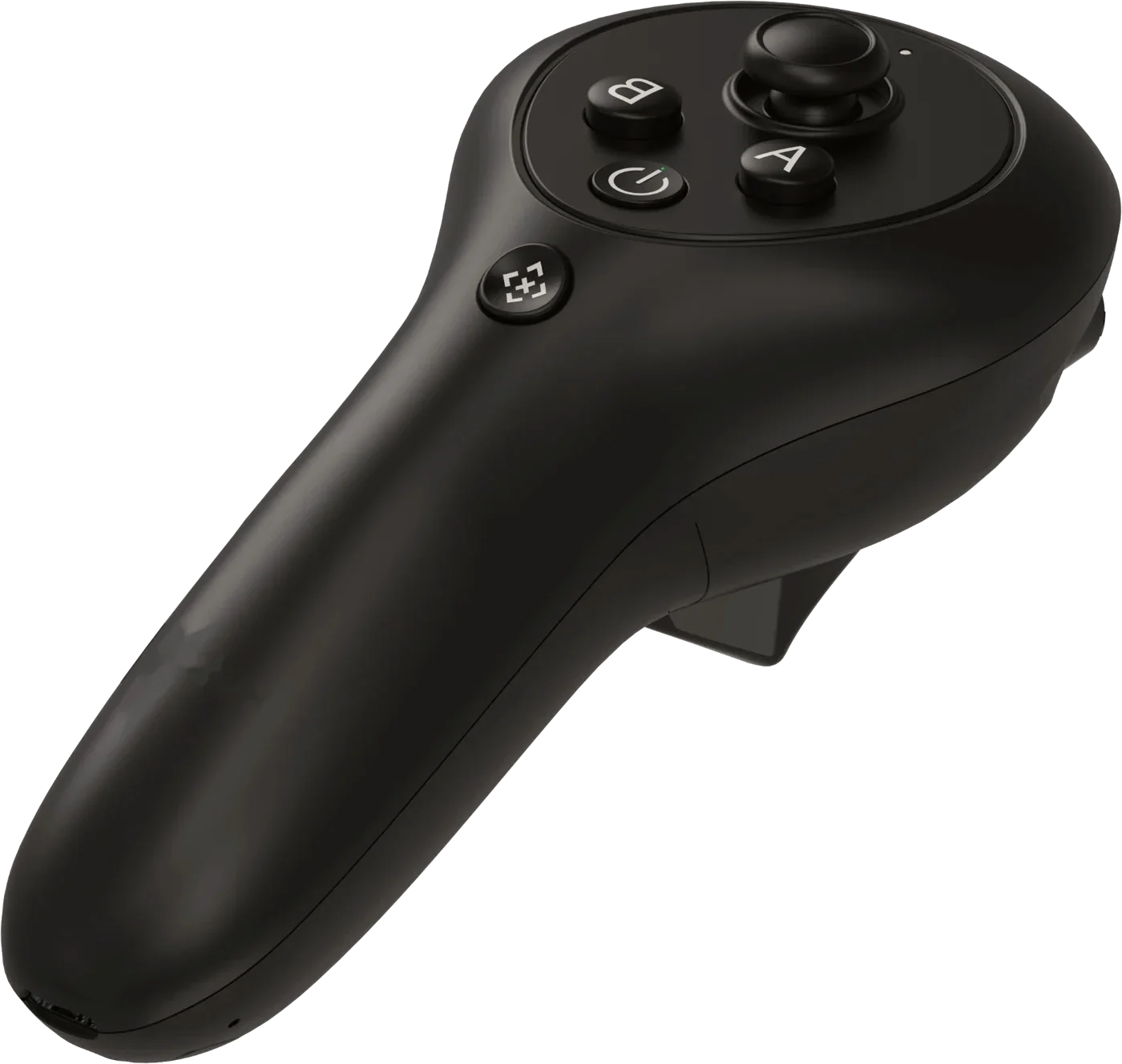
Trackers for robot-learning data use one of four architectures: IR-LED constellations seen by headset cameras, self-tracking camera pucks, IMU-only suits, or hybrids with UWB ranging. Off-the-shelf options are fine for testing, but most cap tracker count, compute pose on-device and lack raw, synchronised data — the requirements a training pipeline needs.
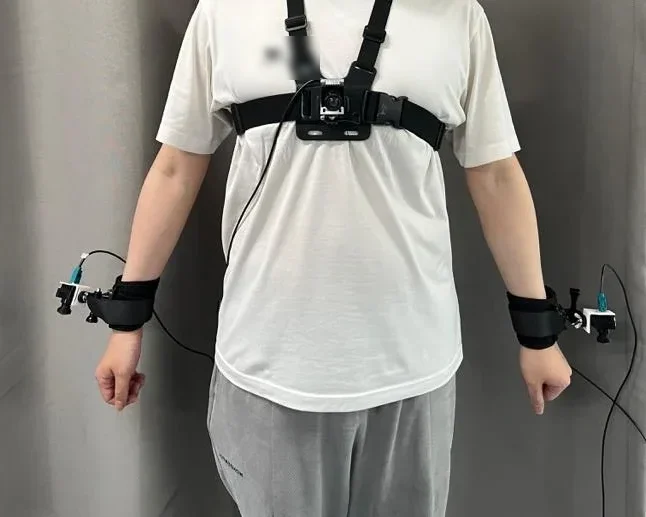
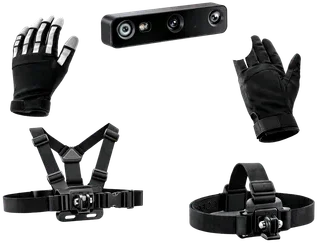
An egocentric headset tells you where the head is and what it sees. Robot learning also needs to know where the hands, body and manipulated objects are, in the same coordinate frame and on the same clock. That is the job of trackers — and it is where many data-collection programs hit an unexpected wall.
Four architectures
| Architecture | How it works | Strengths | Weaknesses |
|---|---|---|---|
| IR-LED constellation (outside-in from the headset) | 8–12 IR LEDs on the tracker; headset cameras see the pattern; pose solved by PnP, fused with the tracker’s IMU | Light, cheap, low power; shares the headset’s frame | Lost when out of the headset’s view (feet, behind the back); LED timing must match camera exposure |
| Self-tracking camera puck | The tracker has its own cameras and runs visual-inertial SLAM; shares a map with the headset | Works out of the headset’s view; no constellation needed | Heavier, more power, on-device pose, map alignment errors |
| IMU-only | Inertial sensors on body segments, skeletal model fuses them | Light, many nodes, no line of sight needed | Position drifts; no absolute object tracking |
| Hybrid + UWB | Any of the above plus ultra-wideband ranging to the headset | Range constraints reduce drift and bridge occlusion | More RF design, antennas and power |
What off-the-shelf delivers (2026)
| Product class | Example | Published characteristics | Fit for training data |
|---|---|---|---|
| Headset-tracked LED puck | Consumer XR body tracker | ~27 g; 12 IR LEDs + IMU; up to 200 Hz; 25 h+ battery; reviewers report ~5 cm average position and ~6° angular deviation | Locked ecosystem; avatar-grade accuracy |
| Self-tracking puck | Consumer inside-out tracker | 94 g; two tracking cameras; up to five per dongle; ~7 h battery; works with PC via dongle | Good for testing body/object tracking quickly; heavy; separate frame from your headset |
| Self-tracking + LED hybrid | Data-collection tracker lines from Shenzhen SLAM vendors | Own VSLAM plus LED tracking; claimed sub-ms to ~100 µs clock sync; pose over 2.4 GHz | Promising; verify weight, tracker count, raw access and launch status |
| IMU suits | Mocap suits and IMU tracker sets | Many nodes, light | Body pose only; no absolute positions or objects |
| Handheld self-tracking controllers | XR controllers | ~160 g class; 1 kHz IMU; on-device pose | Hand-held, not wearable; heavy |
Where programs get stuck
Tracker count. Headset ecosystems that track IR-LED devices commonly support two simultaneously; dongle-based systems five. Full-body plus object tracking typically needs ten or more.
On-device pose instead of raw data. Most trackers output a pose computed by the vendor’s algorithm. A team training its own models needs raw IMU samples, LED event timing and the ability to compute pose itself — or at least to record both.
Synchronisation. Wireless trackers sit on their own clocks. Without continuous offset and drift estimation, their data slides relative to the headset by milliseconds per minute.
Occlusion. LED-only designs lose feet, knees and hands behind the back. Self-tracking or IMU/UWB bridging is needed for whole-body coverage.
Weight and wearability. A 94 g puck on each ankle and wrist changes how people move. For natural demonstrations, 20–25 g is a sensible target.
Should you reverse-engineer an existing tracker?
We advise against it. Consumer tracker protocols are proprietary and usually encrypted; LED pulses are timed to the original headset’s camera exposures; and the result inherits avatar-grade accuracy with legal risk attached. Buying a pair for teardown and benchmarking is useful. Building a data pipeline on a cloned protocol is not.
What a purpose-built tracker needs
| Subsystem | Starting point |
|---|---|
| LEDs | 8–12 × 850 nm emitters, non-symmetric 3D constellation visible over ~270–360°, individually or group-addressable, pulsed at high peak / low duty cycle |
| IMU | 6-axis, 1 kHz, SPI, hardware-timestamped (ICM-42688-P class; check allocation) |
| MCU / radio | Cortex-M4/M33 class with BLE or proprietary low-latency radio (nRF53/nRF54 class), or a UWB SoC with integrated MCU |
| UWB (optional) | DW3000 / QM35-class UWB for ranging and clock alignment with the headset |
| Clock sync | Two-way time transfer or UWB exchange; continuous offset + drift estimation; LED pulses scheduled to headset exposure |
| Power | 150–250 mAh Li-polymer; 12 h at 150 mAh allows ~12.5 mA average before losses |
| Mechanics | 35–45 mm diameter, < 15–18 mm thick, 20–25 g including battery, strap / clip / tapped holes |
| Data | Timestamped raw IMU, LED and UWB events at 1 kHz; pose optional |
The hard parts are not the components — they are LED-to-exposure synchronisation, identifying ten or more trackers reliably, bridging occlusion and hitting the weight target. A realistic path is a first engineering build in six to eight weeks, refined over three to four months, with tracking software either from a SLAM vendor that supports third-party constellations or the client’s own team.
A practical sequence
- This month: buy a self-tracking puck set and an IMU set to test whole-body capture with your pipeline; buy a pair of consumer LED trackers for teardown.
- In parallel: confirm whether your headset vendor can support ten or more trackers and third-party LED constellations, and at what NRE.
- Then: scope a custom puck to your spec only if no vendor path meets count, weight and raw-data requirements.
Related: Timing Is the Spec · Egocentric Data-Capture Hardware: 2026 Buyer’s Benchmark
Frequently asked
Can consumer XR body trackers be used with other headsets?
Not practically. They are tracked by their own headset's cameras over a proprietary, encrypted link, and their LED timing is synchronised to those cameras. Reverse-engineering them for another headset carries technical and legal risk and still yields a device built for avatars, not training data.
How many trackers do I need for full-body robot-learning data?
Typically ten or more: wrists, elbows or upper arms, waist, knees or ankles, plus objects and tools. Many headset ecosystems support only two to five simultaneously, which becomes the bottleneck.
What should a custom tracker puck include?
8–12 asymmetrically placed 850 nm LEDs pulsed in sync with headset exposure, a 1 kHz six-axis IMU, a low-power radio for clock sync and data, optional UWB ranging, a battery sized for a full shift, and a weight target around 20–25 g.
HOLON (2026). Body and Object Trackers for Robot-Learning Data: LED Pucks, Self-Tracking Pucks, IMU Suits and Custom Designs. HOLON-GDE-2026-005, v1.0. https://www.holonai.ai/research/trackers-for-robot-learning