Smart footwear: re-engineering a connected shoe into a foot-mounted fitness instrument
Client: Large footwear manufacturer (India), 10M+ pairs shipped
A high-volume footwear brand already selling a connected shoe wanted a smaller, longer-lasting, smarter next generation. HOLON took the brief apart — power budget, sensing, firmware state machine, packaging — re-scoped it into a buildable product, and led the sensing-module architecture, PCB form factor and firmware plan.
The brief
The client already ships a connected shoe internationally — BLE, an IMU in the sole, an RGB LED, a haptic motor, magnetic charging, step counting and gesture control. The next-generation brief asked for a smaller “invisible” PCB, 15–20 days of battery, richer haptics, an animated LED strip, better touch sensing, tap gestures, activity classification, gait analysis, stable BLE pairing and “no feature conflicts”.
What we found
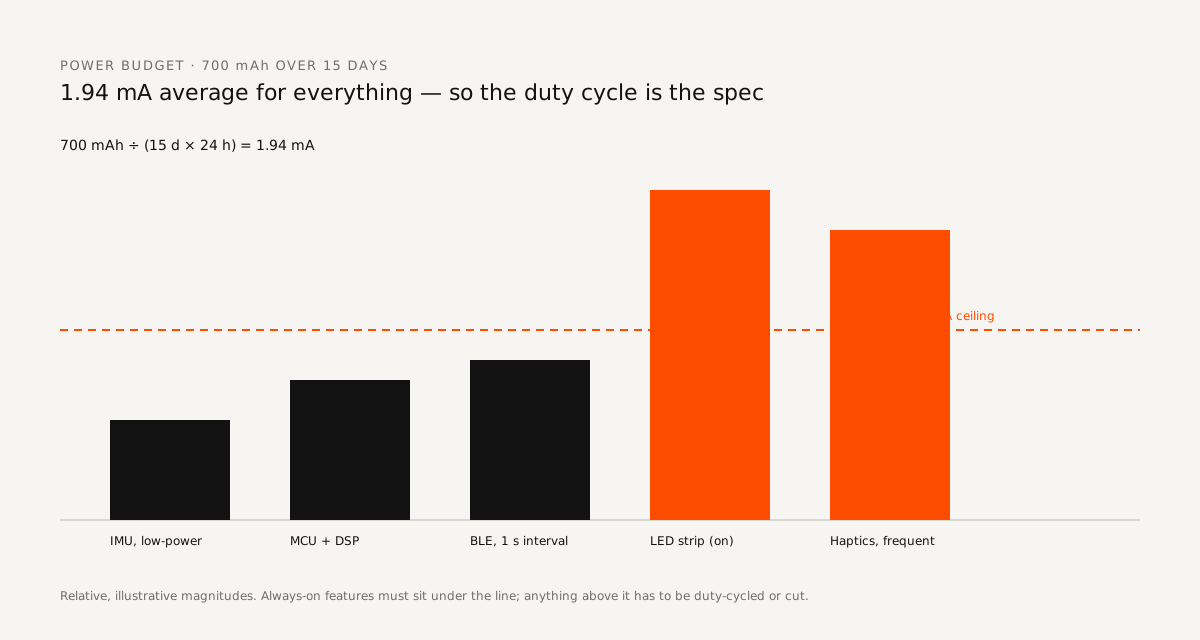
The battery maths did not close. 700 mAh over 15 days leaves 1.94 mA average for everything — IMU, MCU, radio, LEDs and haptics. LED animation and frequent haptics alone break that envelope. 15–20 days is a standby specification, not an active one, and vendor quotes would not be comparable until the duty cycle was locked.
The hardest work was firmware. A footstrike peaks at roughly 2–4 g; an intentional tap at 1.5–3 g. Separating them needs real signal processing, not a threshold. Activity classification needs trained models — yoga looks like sleep to a naive algorithm — and stride length and speed need zero-velocity-update (ZUPT) gait algorithms.
The shoe is a hostile environment. Thousands of compression cycles a day, 30–40° of metatarsal flex per step, acidic sweat, car-interior heat and accidental immersion. Packaging decides reliability as much as circuitry, and LED strips fail at the flex point.
“No feature conflicts” was the actual project. Walking, running, sitting, massage and sleep each need different sensors on and off; the haptic motor and the IMU share the same physical medium. A coordinated state machine with atomic transitions is the product.
What we engineered
- Re-scope: a focused foot-mounted fitness instrument first — single IMU done extremely well, on-device ML for activity and gait, LRA haptics for running-form cues, a 7-day realistic battery target. LED strip, position gestures and touch moved to a lifestyle SKU or v2.
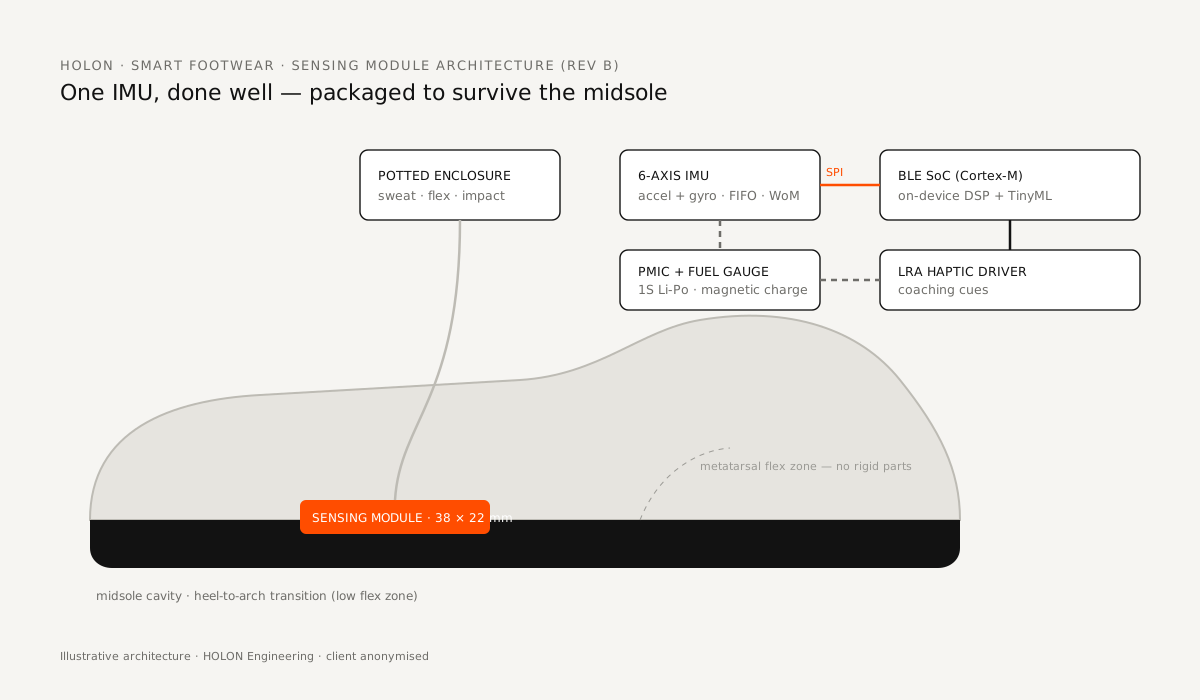
- Sensing-module architecture: 6-axis IMU with FIFO and wake-on-motion, BLE SoC running DSP and TinyML on device, LRA driver, PMIC with fuel gauge and magnetic charging.
- PCB form factor: a compact module sized for the heel-to-arch cavity, away from the metatarsal flex zone, with a potted enclosure for sweat, flex and impact.
- Signal processing: step/tap separation, activity classification pipeline and ZUPT-based gait metrics, developed on reference kits before custom boards.
- Firmware state machine: five device states with explicit coordination rules — e.g. gesture detection off while walking, step counting suppressed while the massage motor runs, force-wake only from deep sleep.
- Programme plan: strategic lock, paid one-week vendor pilots, EVT on reference designs, DVT with a 50-person daily-wear field trial and FOTA from day one, then PVT and launch — 40 weeks instead of the typical 18 months.
Why it matters
The wrist is crowded; ground-contact time, stride asymmetry, pronation and footstrike live on the foot. A manufacturer with its own factories, distribution and an existing smart-shoe customer base is positioned to own that data — if the electronics are engineered for the shoe, not just placed in it.
Building hardware that has to learn? Talk to us.
Send a spec, a sketch, or just the problem. We reply within 24 hours (HKT), usually the same day.